When to Apply for a Credit Card in Canada: What 46 Months of Welcome Bonus Data Show

A welcome bonus is often the largest single reward a credit card pays, and it's the number most card pages lead with. It's also the number that moves the most. The same card can advertise 100,000 points one month and 180,000 a few months later, then drop back.
Most advice on timing an application is anecdotal: "wait for an elevated offer," "apply in the fall." We wanted to see what the record shows. So we went back through archived copies of the issuers' own product pages and logged the public welcome offer on 79 Canadian credit cards, month by month, from January 2023 to October 2026.
This article walks through what that history shows, card by card and issuer by issuer, and how to use it before you apply.
Key findings
- Offers move on most cards. 60 of the 79 cards (76%) changed their public welcome offer at least once. We logged 274 changes in total: 160 increases and 114 decreases.
- Increases are usually temporary. We found 89 increases that later reverted, across 39 cards. The median one lasted 4 months, and nearly two-thirds ended within 4 months.
- Record highs are brief. Cards whose offers moved spent only 21% of their months at their highest recorded offer. In a typical month, the offer was about two-thirds of that card's high.
- There's no reliable season. Increases appeared in every calendar month and were spread almost evenly across the four quarters.
- Issuers behave differently. RBC changed its offers about twice per card per year in our records, and BMO about once every four years.
- The public offer isn't the only offer. Targeted, referral and in-branch offers can differ from what the product page shows, so confirm the offer on the page you apply from.
How we built this dataset
Every CardTruth teardown includes a Welcome Bonus History chart, and this article pools the data behind those charts.
- Source. For each month, we found an archived capture of the issuer's public product page in the Internet Archive's Wayback Machine and recorded the advertised welcome offer. BMO's product pages load their offers by script, so BMO offers come from archived copies of BMO's credit card legal footnotes page. Recent months were recorded from the live pages.
- What we record. We record the total advertised offer, with all tiers combined, plus its conditions. For points cards it's points, and for cash-back cards it's dollars. A month where the page advertised no welcome offer is recorded as zero.
- Coverage. The 79 cards come from Amex, BMO, CIBC, PC Financial, RBC, Scotiabank, TD and Wealthsimple. The 17 cards without a history chart are mostly low-rate, U.S.-dollar and basic cash-back cards, and they aren't part of this analysis. Together the cards cover 2,903 card-months, and 1,982 of them (68%) were observed directly. When a month had no usable capture, we carried the previous month's offer forward.
- Start dates differ. History begins in January 2023 for several issuers. Amex history begins in September 2023 and RBC's in December 2023, which is as far back as the archived pages carry the offer details.
What this data can't see:
- offers that started and ended between two monthly captures
- offers shown only to some visitors (targeted, pre-approved or logged-in offers)
- referral offers, in-branch offers and offers through partner sites
The figures below describe public, advertised offers only.
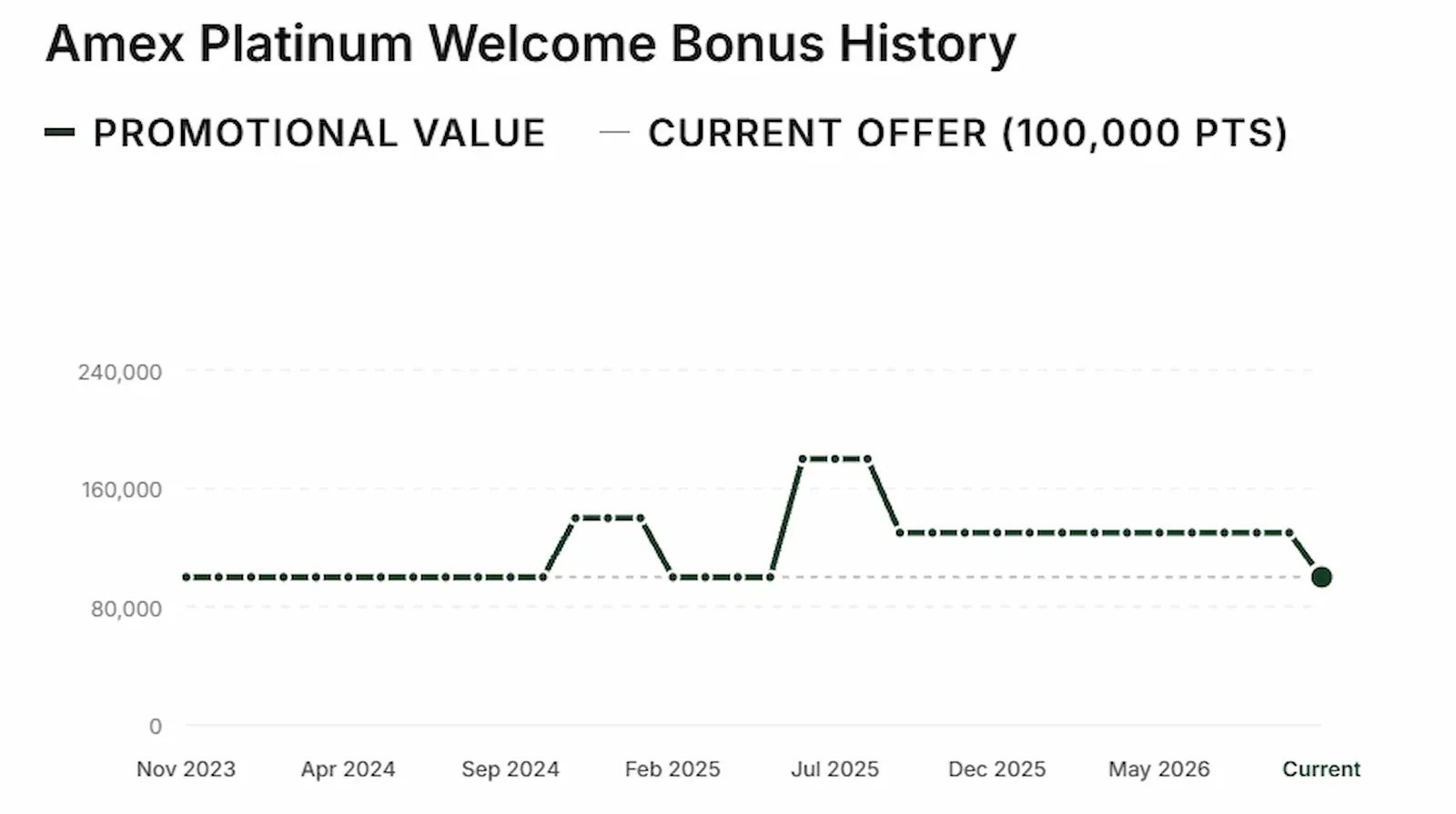 The Platinum Card's public welcome offer, month by month. Each teardown has a chart like this.
Finding 1: most welcome offers change, and they rise more often than they fall
Of the 79 cards, 60 changed their public offer at least once during the period we tracked. The other 19 kept the same offer throughout: 12 of them are no-annual-fee cards, and 7 are BMO cards.
Across the 60 cards that did change, we counted 274 changes:
- 160 were increases.
- 114 were decreases.
More increases than decreases doesn't mean offers only ratchet upward. Many increases were promotions that later ended, and the next section looks at those.
Finding 2: elevated offers usually last a few months
We counted a temporary increase as any rise in a card's offer that later fell back to the earlier level or lower. There were 89 of them, on 39 cards.
| How long the increase lasted | Increases |
|---|---|
| 1 month | 9 |
| 2 months | 14 |
| 3 months | 19 |
| 4 months | 15 |
| 5 to 8 months | 20 |
| 9 months or more | 12 |
- Duration. The median temporary increase lasted 4 months. 57 of the 89 (64%) were over within 4 months, and 9 appeared in only a single monthly capture.
- Size. The median increase was 53% above the offer it replaced. The smallest was 7% and the largest 150%.
Because we sample once a month, some short promotions are missing entirely. The real number of short-lived offers is likely higher than this table shows.
What it means for you: if a card you want is showing a higher offer than usual, history suggests the window is measured in months, not years. If the offer you see is its usual level, an increase has often followed on cards with a history of them, but nothing guarantees one, and waiting has its own cost if you'd use the card now.
Finding 3: a card's best offer is the exception, not the norm
The headline numbers in "best offer" roundups are often record highs. In our data, the 60 cards whose offers moved spent 21% of their months at their own highest recorded offer. For a typical card, the median monthly offer was 64% of its record.
Put another way, if you pick a random month to apply, the offer on most cards will be meaningfully below the best it has been. That's the normal state, not a sign you missed something.
Finding 4: there's no reliable "best month" to apply
Increases in our data were spread across the calendar:
| Quarter | Offer increases | Busiest month |
|---|---|---|
| January to March | 43 | January (16) |
| April to June | 42 | April (16) |
| July to September | 40 | July (20) |
| October to December | 35 | October (15) |
- July had the most increases (20).
- December had the fewest (6).
Beyond that, the spread is too even to support a rule like "apply in the fall." Offer changes are better tracked card by card than by calendar.
Finding 5: each issuer has its own rhythm
To compare issuers fairly, we divided each issuer's offer changes by the number of card-years we observed for it.
| Issuer | Cards tracked | Offer changes per card per year |
|---|---|---|
| RBC | 13 | 2.1 |
| PC Financial | 4 | 1.3 |
| CIBC | 17 | 1.2 |
| Scotiabank | 12 | 1.2 |
| American Express | 13 | 1.0 |
| TD | 7 | 1.0 |
| BMO | 11 | 0.3 |
- RBC changed offers most often. Several RBC cards alternated between two or three levels within the same year.
- BMO's offers were the steadiest in our records. They come from BMO's legal footnotes page rather than its product pages, which may smooth out short promotions.
- Wealthsimple is left out of this table: each of its two cards has less than a year of history.
Card by card: what the history looks like
Patterns are easier to see on specific cards. All figures are the total public offer as advertised, with all tiers combined. Each card's teardown has the full month-by-month chart.
The Platinum Card from American Express: two large, temporary increases
The Platinum Card advertised 100,000 Membership Rewards points when our record for it begins (November 2023).
- November 2024: rose to 140,000. Back to 100,000 in February 2025.
- June 2025: rose to 180,000, its highest recorded offer. Eased to 130,000 in September 2025.
- October 2026: back to 100,000.
The current offer is split: 70,000 points after $10,000 in purchases in 3 months, and 30,000 for a purchase made in months 15 to 17. That second tier arrives after the second annual fee is billed, which is worth factoring in. See the Amex Platinum teardown for the fee, the point value and the conditions.
American Express Cobalt Card: a cut that stuck
The Cobalt offered 30,000 points until November 2023. It dropped to 15,000 in December 2023 and hasn't changed in the 34 months since. Not every decrease is the end of a promotion. Sometimes the standard offer itself is reset. The current 15,000 points are earned monthly, by spending $750 a month for 12 months. Amex Cobalt teardown.
Scotiabank Passport Visa Infinite+ Card: a long plateau, one spike
For three years the Passport card moved between 35,000 and 45,000 Scene+ points. In January 2026 it rose to 60,000, stayed there for seven months, and returned to 35,000 in August 2026. Scotiabank Passport Visa Infinite+ teardown.
RBC Avion Visa Infinite: frequent swings, currently at its high
The Avion Visa Infinite has alternated between 35,000 and 55,000 Avion points since 2024.
- May 2026: it reached 70,000.
- August 2026: dipped to 55,000.
- September 2026: back to 70,000, its highest recorded offer.
The current total includes a 15,000-point anniversary portion, so check which parts of the total arrive in year one. RBC Avion Visa Infinite teardown.
TD First Class Travel Visa Infinite Card: big numbers, different point value
TD's offer has ranged from 75,000 to 165,000 TD Rewards points and stands at 160,000 as of October 2026. Point totals aren't comparable across programs, because a TD Rewards point is worth a fraction of a Membership Rewards point. Compare offers in dollars, not points. The teardown's Points & Redemption section shows what the points are worth. TD First Class Travel teardown.
PC Insiders World Elite Mastercard: from a record to no offer
This card advertised 300,000 PC Optimum points (worth $300) in mid-2024.
- September 2025: the offer was removed. The product page showed no welcome offer until March 2026.
- April 2026: 50,000 points ($50) appeared, and that's the offer as of October 2026.
PC Insiders World Elite teardown.
CIBC Dividend Visa Infinite Card: cash-back offers move too
Cash-back cards follow the same pattern. The Dividend Visa Infinite advertised no welcome offer until early 2024. Since then it has moved between $200 and $350, and it's $250 as of October 2026. CIBC Dividend Visa Infinite teardown.
Where offers stand in October 2026
Among the 60 cards whose offers have moved:
- 27 are at their highest recorded offer.
- 33 are below their high.
- 25 cards changed their offer between August and October 2026, so this snapshot will date quickly.
Every teardown's chart is updated monthly, so check the card you're considering rather than relying on this list.
| Card | October 2026 offer | Highest recorded |
|---|---|---|
| RBC Avion Visa Infinite | 70,000 pts | 70,000 pts |
| Scotiabank Gold American Express | 50,000 pts | 50,000 pts |
| CIBC Aeroplan Visa Infinite | 50,000 pts | 50,000 pts |
| TD Aeroplan Visa Infinite | 50,000 pts | 70,000 pts |
| Amex Aeroplan Reserve | 85,000 pts | 130,000 pts |
| Amex Gold Rewards | 60,000 pts | 110,000 pts |
| The Platinum Card (Amex) | 100,000 pts | 180,000 pts |
| Scotiabank Passport Visa Infinite+ | 35,000 pts | 60,000 pts |
The teardowns for the cards in this table:
- Scotiabank Gold Amex
- CIBC Aeroplan Visa Infinite
- TD Aeroplan Visa Infinite
- Amex Aeroplan Reserve
- Amex Gold Rewards
Offers you won't see on the product page
The history above covers the offer every visitor sees. Issuers also run offers that never appear there:
- Targeted and pre-approved offers, by mail, email or inside your online banking or the issuer's app.
- Referral offers. Existing cardholders can send these, and they can be higher or lower than the public offer.
- In-branch and partner offers, such as offers at a bank branch, through an airline or retailer partner, or on a comparison site.
- Short promotions that start and end between our monthly checks.
So the offer you're shown may not match a teardown's chart or this article. That's expected, and the version that counts is the one in the terms of the application you submit. Confirm the current offer on the issuer's page before you apply.
A checklist before you apply
- Look at the card's history. Each teardown's Welcome Bonus History chart shows whether today's offer is typical, high or low for that card.
- Separate the headline from year one. Many offers combine tiers: points on approval, points after a spending threshold, and points in month 13 or on the anniversary. Add up what you'd receive before the second annual fee.
- Convert points to dollars. 100,000 points can be worth very different amounts depending on the program. Each teardown's Points & Redemption section shows the guaranteed value and our estimate.
- Check the spending requirement against your real spending. A bonus that needs $10,000 in three months only pays off if that spending was going to happen anyway.
- Read the eligibility terms. Many offers exclude current or former cardholders of the same card, and some issuers limit how often you can earn a bonus. The Amex Cobalt teardown, for example, lists the restrictions on its first-year offer.
- Save the offer terms. Take a screenshot or PDF of the offer and its conditions on the day you apply, in case you need to refer to them later.
Frequently asked questions
Is there a best time of year to apply for a credit card in Canada?
Not based on public offers since 2023. Increases happened in every month and were spread almost evenly across the quarters. Tracking the specific card you want is more useful than waiting for a season.
How long do elevated welcome offers usually last?
In our data, the median temporary increase lasted 4 months, and nearly two-thirds ended within 4 months. Some lasted a year or more, and some appeared in only one monthly capture.
Why is the offer I see different from the one on CardTruth?
Our charts record the public offer on the issuer's product page once a month. You might be seeing a targeted, referral or in-branch offer, or the public offer may have changed since our last update. The offer in your application's terms is the one that applies.
Are bigger point totals always better offers?
No. Point values vary by program, offers are often split across tiers that arrive at different times, and the annual fee comes off the top. Compare the dollar value you'd receive in the first year against the fee and the spending required.
Methodology and updates
This analysis uses the welcome-bonus records behind CardTruth's teardown charts as of October 2026.
- Sources. Each monthly entry is sourced to an archived or live copy of the issuer's public page, with the archive URL and the offer wording kept on file.
- Updates. We add a new month to each card's history as we check its offer, and we'll update these figures periodically.
- Not advice. This is general information, not financial advice. Read the issuer's offer terms and cardholder agreement before you apply.
CardTruth.ca reads the cardholder agreement so you know what to look for. Every teardown finding is sourced to a specific clause, and every welcome offer to the page it appeared on.